How the University of Michigan Is Building the Backbone of the New Space Era
This article explores how Michigan’s aerospace labs, CubeSat teams, and hypersonics research are quietly shaping the infrastructure behind modern space missions. From spacecraft systems engineering to propulsion and materials science, this piece examines how Michigan is training engineers to build the complex, integrated systems that make next-generation spaceflight possible.
FUTURE OF AEROSPACE
Vince Sanouvong
1/26/20263 min read
The future of space exploration is no longer defined only by giant rockets and historic missions. It is defined by integrated systems: networks of satellites, autonomous spacecraft, advanced materials, propulsion technologies, and mission architectures that must function together in unforgiving environments. In this New Space era, success depends not on isolated breakthroughs but on the ability to design, build, and operate complex aerospace systems.
At the University of Michigan, aerospace engineering is increasingly shaped by this reality. Across its labs, student teams, and research programs, Michigan is training engineers to become systems level thinkers who will build the backbone of tomorrow’s space infrastructure.
From Classroom to Flight Hardware
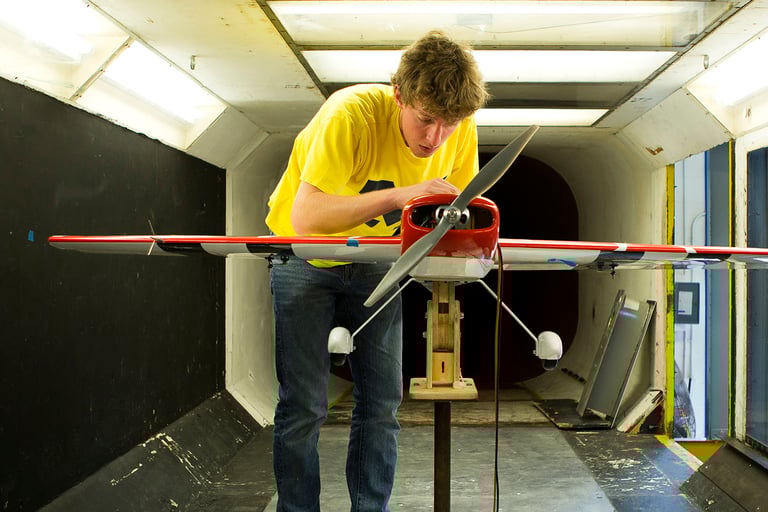
Michigan’s aerospace culture emphasizes that engineering must live beyond the page. Students are not only solving equations. They are building, testing, and flying real hardware. Whether it is spacecraft components, experimental vehicles, or flight ready subsystems, Michigan students are exposed early to the full engineering lifecycle including design, analysis, fabrication, integration, and validation.
One example of this culture is the Michigan Exploration Laboratory, or MXL, which leads the development of flight tested CubeSats and space systems. Through programs like MXL, students work on spacecraft that are designed, built, and operated by Michigan engineers, giving them experience that mirrors what they will encounter in industry and national space programs.
CubeSats and the Democratization of Space
One of the most powerful forces reshaping spaceflight today is the rise of small satellites. CubeSats and SmallSats now perform tasks once reserved for billion dollar spacecraft including Earth observation, communications, scientific research, and technology demonstrations.
Michigan has become deeply involved in this transformation through organizations like the Michigan Exploration Laboratory and MASA, the Michigan Aeronautical Science Association. Michigan students have designed and flown CubeSats that conduct real scientific and engineering missions in orbit, contributing to a growing network of small spacecraft that form the nervous system of modern space infrastructure.
These projects teach students how to build spacecraft that must survive launch, operate autonomously, and transmit data across hundreds of thousands of kilometers, all while fitting inside something the size of a shoebox.
Hypersonics and High Speed Flight
While small satellites define one end of the New Space spectrum, hypersonic flight defines another. Vehicles traveling at more than five times the speed of sound face extreme aerodynamic heating, structural stress, and control challenges that push the limits of materials and modeling.
Michigan is a leader in this domain through research groups like the Gas Dynamics Laboratory and the Plasmadynamics and Electric Propulsion Laboratory, which explore high speed aerodynamics, plasma flows, and advanced propulsion concepts. This research supports both atmospheric flight and space access, helping develop the technologies that will enable faster, more efficient vehicles for future missions.
By working in these labs, Michigan students are trained to handle some of the most demanding environments in aerospace engineering.
Training Systems Engineers
What truly distinguishes Michigan’s aerospace ecosystem is not any single lab or project. It is the systems level mindset that runs through all of them.
Modern spacecraft and aircraft are not built by specialists working in isolation. They are built by engineers who understand propulsion, structures, avionics, software, and mission design as part of one integrated whole. Michigan’s programs emphasize this reality by encouraging cross disciplinary thinking, project based learning, and real world problem solving through organizations like MASA and MXL.
This produces graduates who are not just technically capable but operationally aware, people who can step into industry, research labs, or mission teams and immediately contribute.
Michigan and the New Space Economy
The New Space era is being driven by private launch companies, satellite networks, defense innovation, and lunar and planetary missions. All of these depend on engineers who can navigate complexity and uncertainty.
Michigan’s aerospace research ecosystem spanning CubeSats, high speed flight, and advanced propulsion aligns directly with this future. Its students are learning to build the infrastructure that will support everything from Earth observation constellations to deep space missions.
A Backbone for the Future
As humanity expands further into space, the most important achievements will not always be the most visible. They will be the systems that quietly work in the background, the satellites, vehicles, and networks that make exploration, science, and commerce possible.
Through its labs, student organizations, and hands on engineering culture, the University of Michigan is playing a key role in building that backbone. In doing so, it is training the engineers who will carry the New Space era forward.